VR
VR 中文
中文 ENGLISH

“The second the curtain went up, I knew something was wrong,” says veteran lighting designer Chen, reflecting on the opening night of a major theatrical production. The costume team had spared no expense on a deep burgundy velvet gown, crafted to evoke vintage glamour—its fabric shimmered with rich, true color during backstage fittings. The actors’ natural makeup, refined through dozens of tests, was designed to highlight subtle skin textures and emotional depth. But when the stage lights hit, the gown turned a dull, ashy red, and the cast’s complexions looked sallow and uneven. Post-show feedback was clear: “The visuals felt disconnected.” After weeks of troubleshooting, Chen found the root cause: the moving head lights lacked sufficient Color Rendering Index (CRI), failing to reproduce the true colors of costumes and skin.
For theater managers, lighting designers, and high-end event planners, this story is all too familiar. A standout performance relies on more than great acting or elaborate costumes—it hinges on the “invisible backbone” of lighting. Among all lighting specs, CRI is the make-or-break metric for color accuracy and audience immersion. In this guide, we’ll break down why high CRI is non-negotiable for professional moving head stage lighting, its real-world impact, and how industry leaders like XMLITE are solving longstanding industry challenges.
 What Is CRI, and Why It Matters for Moving Head Lights?
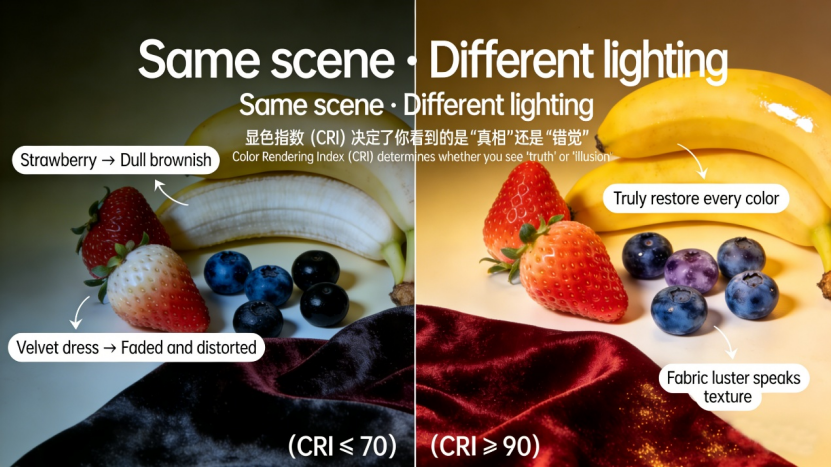
CRI, short for Color Rendering Index, measures a light source’s ability to reveal an object’s true color, scored on a scale of 0 to 100. The higher the CRI, the closer colors match their appearance under natural sunlight; lower scores mean distorted, faded hues.
Think of it this way: Place a platter of fresh fruits—strawberries, bananas, blueberries—under two lights. Under a high CRI light (≥90), the strawberries glow bright red, bananas radiate warm yellow, and blueberries shine deep purple, each with vivid texture. Under a low CRI light (≤70), those colors flatten: strawberries look maroon, bananas turn pale, and details blur into a washed-out mess.
For professional stages, CRI’s importance is amplified. Every color on stage tells a story—conveying emotion, character, and setting. Distorted colors don’t just ruin the visual experience; they can confuse the audience’s understanding of the plot. Whether it’s a heartfelt monologue or a dynamic concert set, high CRI ensures the creative vision comes across as intended.
High CRI’s Transformative Role in Key Professional Scenarios
High CRI isn’t a “nice-to-have”—it’s a must-have for scenarios where color accuracy defines success. Here’s how it elevates critical applications:
Theater Performances: True Skin Tones and Costume Textures
In theater, actors’ complexions and costumes are powerful storytelling tools. High CRI moving head lights capture every nuance: the paleness of sorrow, the flush of excitement, or the weathered tone of a seasoned character. Fabrics shine as designed—burgundy velvet exudes luxury, while soft linen feels authentic—drawing the audience deeper into the scene. Low CRI lights, by contrast, turn skin tones sallow or gray and strip costumes of depth, breaking the spell of immersion.
TV Studios: Consistent Color for On-Screen Perfection
TV studios demand uncompromising color accuracy—cameras amplify even the smallest distortions for at-home viewers. High CRI moving head stage lighting ensures hosts’ skin looks natural, guests’ outfits stay true to their intended colors, and backdrops/props match pre-production visions. This eliminates the frustrating gap between “looks great live” and “looks off on camera,” safeguarding the show’s professional reputation.
Museum & Gallery Lighting: Preserving Artistic Integrity
Artworks and artifacts are sensitive to light—requiring UV-free, low-heat illumination and high CRI. High CRI moving head lights reveal paintings in their true glory: Van Gogh’s Sunflowers glow with vibrant yellow, and Monet’s Water Lilies bloom in soft violet. They also highlight textures: the patina on bronze relics, the weave of ancient textiles, or the brushstrokes in a masterpiece—letting visitors experience art as the creator intended.
Industry Challenges & XMLITE’s High CRI Solutions for Moving Head Lights
Traditional film and TV fixtures easily achieve high CRI, but moving head lights—valued for their flexibility and dynamic effects—have lagged behind. Most manufacturers either overlook CRI or struggle to deliver it due to technical barriers. XMLITE, a 15-year leader in moving head light innovation, identified this gap and developed targeted solutions.
Not all moving head lights need the same CRI: Beam lights prioritize light paths over color, so CRI is irrelevant; pattern lights have minimal CRI needs. But profile moving head lights (which shape stage visuals) and wash lights (which flood areas with color) demand high CRI—they’re directly responsible for color fidelity.
Profile Moving Head Lights: Two Custom High CRI Options
XMLITE offers flexible solutions to balance high CRI and brightness:
· Custom Light Sources:
Standard light sources typically hit 75-80 CRI, insufficient for professional use. XMLITE crafts custom sources with 90+, 95, or even 98 CRI. Note: High CRI reduces brightness by ~30%, and specs are fixed—ideal for plays, small concerts, or venues prioritizing color over extreme luminosity.
· CRI Enhancement Filters:
A versatile fix that boosts CRI to ~90 without modifying the light source. The best part? Instant switching: Remove the filter via console for high-brightness moments (e.g., concert peaks) and reattach for color-critical scenes. Perfect for large events needing both power and precision.
Wash Lights: LM660—Breaking the High CRI vs. Color Temperature Barrier
Most wash lights use RGBW 4-color sources. While theoretically capable of high CRI, they suffer from clunky adjustments and instability. Worse, traditional high CRI wash lights lose accuracy when switching between warm and cool temperatures—because color temperature changes disrupt the continuous spectrum needed for consistent CRI.
XMLITE’s LM660 wash light solves this with innovative RGBACL 6-color sources and precision color calibration. It delivers stable high CRI even as color temperature shifts, letting designers toggle between 3200K (warm) and 6500K (cool) without sacrificing color truth. With 37x20W LEDs, it outputs 8816-10315 lumens, blending power and precision: 90.2+ Ra and 61+ R9 (critical for red accuracy) across all temperatures—outperforming 4-color alternatives (65.5-70.9 Ra) by a wide margin.
Comparison Table: 4-Color vs. 6-Color LED Wash Lights
Product Model | Light Source Configuration | Power | Color Temperature | Luminous Flux | Color Rendering Index (Ra/R9) |
37 pcs 20W, RGBACL 6-color | 495W | 3200K | 8816 lm | Ra=90.2, R9=61 | |
37 pcs 20W, RGBACL 6-color | - | 5600K | 10114 lm | Ra=93, R9=71 | |
37 pcs 20W, RGBACL 6-color | - | 6500K | 10315 lm | Ra=94, R9=76 | |
37 pcs 15W, RGBW 4-color | 590W | 3200K | - | Ra=65.5 | |
37 pcs 15W, RGBW 4-color | - | 5600K | - | Ra=70.9 | |
37 pcs 15W, RGBW 4-color | 610W | 6500K | - | Ra=88.4 |
Why High CRI LED Moving Head Lights Are So Rare
If high CRI is critical, why do most LED moving head lights fall short? It comes down to cost vs. quality.
Achieving high CRI requires premium chips, precision optical design, and extensive R&D for color calibration—driving up production costs. Many manufacturers prioritize affordability for the mid-market, cutting corners on CRI.
XMLITE takes a different approach: High CRI is a non-negotiable standard for professional moving head stage lighting. The investment pays off: Professional lighting’s core purpose is to enhance performance quality and audience experience—and high CRI is the foundation of that mission.
Invest in High CRI: Secure Long-Term Performance Excellence
For theater managers, lighting designers, and event planners, high CRI moving head stage lighting isn’t an extra expense—it’s a long-term investment in reputation and audience satisfaction. A performance with accurate colors deepens emotional connection, elevates artistic impact, and turns casual attendees into loyal patrons. Conversely, low CRI wastes investments in costumes, makeup, and set design—undermining the entire production.
To help industry professionals master CRI and light quality, XMLITE has published the White Paper on CRI & Light Quality for Professional Stage Lighting. It covers CRI science, scene-specific CRI guidelines, and high CRI application tips—essential reading for anyone upgrading lighting systems or planning high-end events.
Click the link below to fill out the form, download the white paper for free, and access detailed specs for XMLITE’s high CRI professional moving head lights. Whether you’re outfitting a theater, designing a concert tour, or planning a luxury wedding, XMLITE’s team provides one-on-one customization—empowering your vision with the color accuracy that makes performances unforgettable.